Five articles exploring how organizations classify, preserve,
circulate, and make effective use of knowledge.
These articles were written independently in 2013 and 2014 for Style Matters, a Philadelphia based company offering knowledge management services.
August 6, 2013
A Century of Knowledge Management
Illustration from Manual of library classification and shelf arrangement, 1898
Knowledge management specialists owe an enormous debt to Melvil Dewey.
Although the term “knowledge management” has only been in common usage
since the early 1990s, well over a century after he created his Dewey
Decimal System in 1876, Dewey could well be said to be the grandfather
of the discipline, inspiring knowledge managers generations later.
Dewey’s genius was his recognition that an enormous reservoir of
knowledge is useless without a system in place to selectively retrieve
that knowledge. Before Dewey’s brilliant innovation, librarians faced
the daunting task of organizing thousands of books without any clearly
defined hierarchical structure, and knowledge-seekers endured the
frustration of knowing that the answers they sought were available
somewhere in the vast collection of disorganized tomes those librarians
oversaw, with no clear guide as to exactly where.
Knowledge Management Comes of Age
Many companies today find themselves in a similar predicament as those
19th-century, pre-Dewey librarians. They are tasked with facilitating the
retrieval of information from a vast and often poorly organized pool, but
lack an effective process to do so efficiently and systematically.
While Dewey’s innovation provided a system for knowledge management
throughout most of the 20th century, the explosion of information
technology at the end of that century raised the bar to levels unforeseen
just a few decades earlier. It was only in the 1990s that the term
knowledge management began to be used to describe this altogether new
discipline, building on the library science established in the previous
century by Melvil Dewey, but incorporating technology and communication
media that had in only a few years become ubiquitous.
Knowledge Management Pioneers
Following in the footsteps of Melvil Dewey, visionary Peter Drucker
foresaw that information was the commodity of the future. He coined the
term knowledge worker in 1959 and has been in the vanguard of the
information revolution. In a 1988 Harvard Business Review
article, he observed that the typical business of the future:
. . . will be knowledge-based, an organisation composed largely of
specialists who direct and discipline their own performance through
feedback from colleagues, customers and headquarters. For this reason
it will be what I call an information-based organisation. In such an
organisation, the management of knowledge and information becomes a key
to gaining competitive advantage.
Other pioneers in this emerging field include Knowledge Research
Institute’s Karl Wiig, often credited with coining the term “knowledge
management” in a paper discussing his work on artificial intelligence in
1986, Thomas Davenport, one of the first to more explicitly define the new
term in a 1994 article in the Harvard Business Review
(“Knowledge management is the process of capturing, distributing, and
effectively using knowledge.”), and Jason Frand and Carol Hixon of the
UCLA Anderson School of Management, who wrote a highly influential paper
in 1999, describing the sea-change in the very nature of managing
knowledge that computers and the Internet would bring to the 21st century.
Ever More Knowledge to Manage
Melvil Dewey founded the first school of library science in 1887 at
Columbia University. In recent years an average of almost 5,000 Master’s
Degrees in library science are awarded in the US every year. As
information technology continues to expand, it is crucial for companies
to stay on top of the exponentially growing field of knowledge
management, employing competent knowledge management professionals and
knowledge management specialists.
The Information Age is here to stay. Knowledge management strategies are
essential to survival and prosperity in this new and exciting silicon
era. Melvil Dewey would be proud.
October 22, 2013
Don’t Know Much About Taxonomy
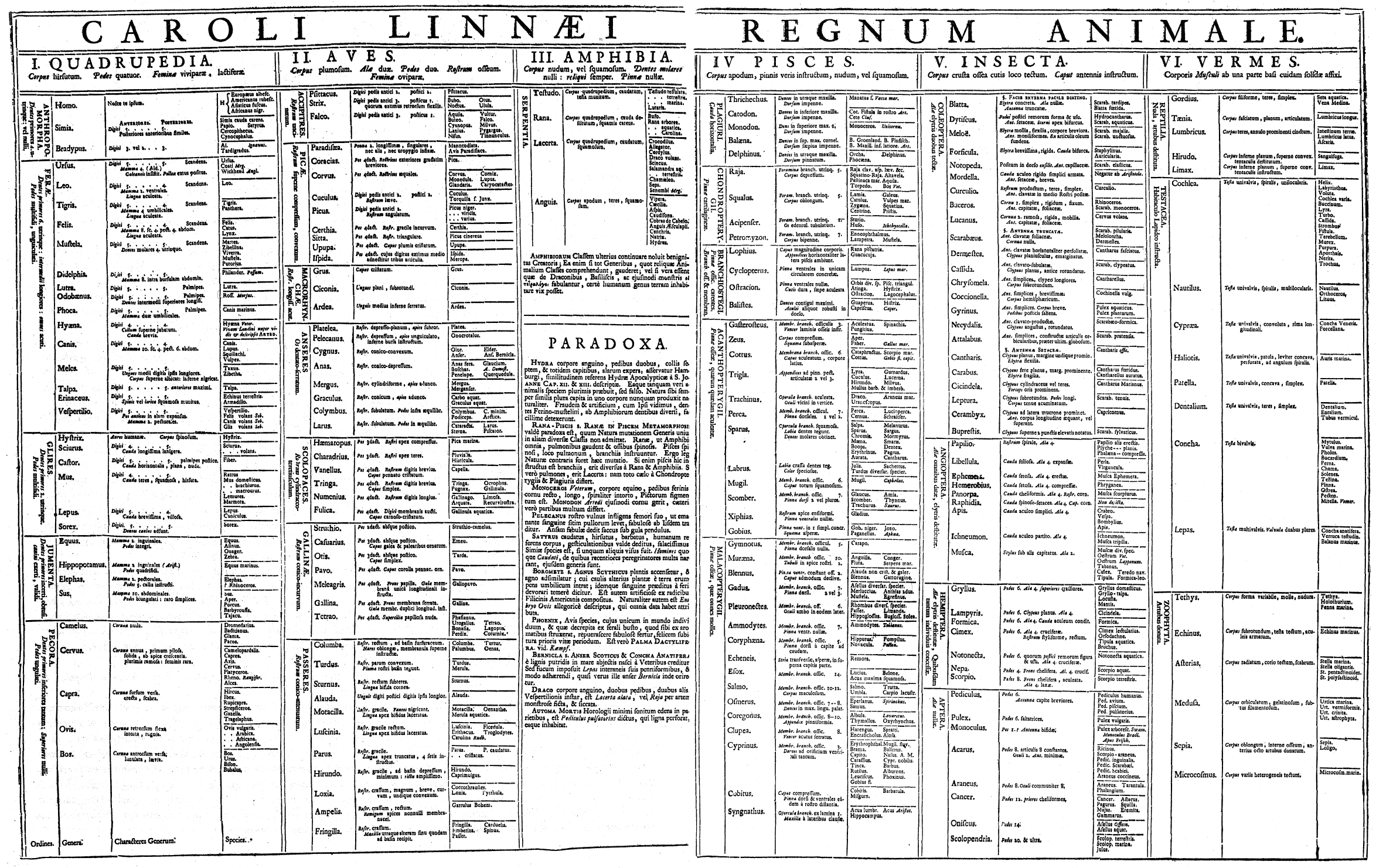
The animal kingdom table from the first edition of Carl Linnaeus’s Systema Naturae (Nice first draft, Carl, but whales aren't fish.)
Today’s knowledge management specialists must manage a rapidly expanding
pool of knowledge. Without a well-designed organizational structure, gross
inefficiencies will attend retrieving and amending that knowledge base,
wasting time, money and opportunities. To meet this challenge, many
businesses have taken a page from their old biology textbook. Their
knowledge management strategies incorporate the development of a business
taxonomy.
Taxonomy is the practice and science of classifying things or concepts,
and the principles that underlie such classification. It most often
describes biological taxonomy, classifying the many thousands of different
extant and extinct organisms in a logical hierarchy according to their
natural relationships, as first laid out by Carl Linnaeus in his
groundbreaking Systema Naturae in 1735.
Biological Taxonomy
Systema Naturae stands, along with Newton’s
Principia Mathematica and Darwin’s
On the Origin of Species, as one of the most influential
science texts of all time. The ideas expressed have grown and expanded
dramatically in the subsequent centuries, and continue to do so today,
but the underlying principles remain.
The essential operation in creating a taxonomy is dividing a very large
number of items into a manageable number of smaller groups, each of which
is defined by rigorously outlined criteria. Each of those groups is divided
into subgroups, which are in turn divided into even smaller subgroups, and
so forth.
Biological taxonomy starts with large groups, including animals and plants.
Animals can be divided into vertebrates and invertebrates, plants into
flowering and non-flowering plants. Vertebrate animals can be further
divided into mammals, reptiles, birds, fish and amphibians.
Mammals include numerous subgroups, including primates, and these, in turn,
contain even more extensively defined subgroups, including our own
Homo sapiens.
When Linnaeus began his classification system, there were only about 6,000
species of plants and fewer than 5,000 species of animals identified.
Today there are close to two million identified species, all classified
within the well-defined framework of modern biological taxonomy.
Useful Distinctions
The informational resources of modern-day knowledge managers in any
business can benefit from organization in a similar hierarchical structure.
The most important element in designing a useful taxonomy is understanding
the relevant distinctions between the individual items being organized.
What information is similar enough that it should be grouped together?
What distinctions are important enough that they should be used to
discriminate between different content items, relegating some to one group
and otherwise similar content to a different group?
For a biologist, dividing all animals into vertebrates and invertebrates is
a logical and useful way to cleave the set of thousands of animals into two
neat subgroups. For a business, the most logical distinction between the
thousands of individual knowledge resources might be customer-facing
versus internal content, for example.
Rigorous Definition
Another key to designing a successful business taxonomy is ensuring very
careful and rigorous definitions of the various groups. If the definitions
are clear and unambiguous, everything will fall naturally into its proper
place. If the definitions lack rigor, and interpretation becomes
subjective, different individuals might classify the same piece of content
in a very different way.
If you were creating a subdivision of content that applied specifically to
“small businesses,” it’s important to spell out exactly what defines a
small business. You might use any of a variety of criteria, including total
volume of sales, profits or structure of incorporation. Which criteria you
decide upon depends on what distinctions are most useful to make. But
wherever you decide that the lines are drawn, it’s important that the
distinctions are clearly and objectively defined.
Trial and Error
Page 75 of the tenth edition of Systema Naturae Whales are no longer fish.
In Linnaeus’s first edition of Systema Naturae, whales were
classified as fishes. Today, of course, they share with us humans the
mammalian class. Linnaeus himself corrected this in his 1758 revision. His
first edition, in 1735, comprised only 11 pages. By the 12th edition, in
1768, it had grown to 2,400 pages.
Vigilance and attention to detail are essential to developing and
maintaining an effective business taxonomy. Your first best guess as to
what differentiation criteria and definitions will be most appropriate
might not turn out to be as useful in practice as they did in theory.
Successful knowledge management specialists start with a flexible
framework encompassing the big picture, refining the process and filling
in the details based on experience and careful observation.
Knowledge Management Solutions
Developing a business taxonomy for organizing informational content is an
increasingly popular knowledge management solution for many of today’s
successful companies. If you run a business and find that your knowledge
base has become unmanageably extensive and complex, consider partnering
with a knowledge management company with experience in taxonomy
development and implementation to organize that chaotic content into an
ordered hierarchy.
Do it right, and you can be an A student, baby. Even if you don’t know
much about your science book.
November 14, 2013
Tacit Knowledge
We can know more than we can tell.
Valentine Conwell Taber Studios, 1895
Do you remember learning how to ride a bicycle? It was tough. You may have earned a few bumps and bruises on the way to mastering that skill. Now think about how much easier it would have been if you had had a detailed instruction manual outlining all the necessary procedures to operate the vehicle. Probably not at all. Riding a bike is an example of tacit knowledge, the sort of knowledge that cannot be adequately conveyed in writing.
Explicit Knowledge and Tacit Knowledge
The first step that many knowledge management specialists take is to make a distinction between explicit knowledge and tacit knowledge, a term popularized by the above-quoted Michael Polyani in 1958 in his highly influential book, Personal Knowledge. Explicit knowledge can be written down. And if it can be, it should be.
Clearly written instructions that spell out exactly how to perform a task, company policies and procedures that affect decision-making and useful factual information that employees need in order to fulfill their duties should always be written down as lucidly as possible, and updated regularly so that everyone in the company is on the same page. Otherwise, different cohorts of employees will be working with different facts and conceptions of policies.
But not all knowledge can be so easily contained and conveyed. Managing tacit knowledge requires different approaches than managing explicit knowledge does.
Shadowing
Someone who has been doing the same job for years has probably amassed a significant pool of tacit knowledge of which he or she is not even consciously aware. If asked to create a training manual for a successor, that employee might be as lost as you would be writing instructions to your child on how to ride a bike. The best way for that successor to master the skills possessed by the veteran may be to work directly alongside him and observe firsthand how he does what he does so well.
Medical students read an awful lot of books on their way to becoming cardiac surgeons. But nobody in his right mind is going to be comfortable with a doctor poking around his chest, based solely on her impressive academic credentials. Knowing that your surgeon has read all the books and passed all the tests is simply not enough.
Surgeons master the finer points of their life-saving craft by working directly with experienced surgeons as they perform surgery on real patients. First, simply observing, then assisting, then operating under the close supervision of their more experienced colleagues, until they are finally prepared with both the tacit and explicit knowledge needed to operate on their own.
Joint Problem Solving
Similar to shadowing, joint problem solving puts the learned master and eager apprentice together to work toward a clearly-defined objective. The novice is not merely observing. He’s assisting with the process, providing input and suggestions.
This approach can benefit the more experienced participant as well as the newcomer. That newcomer might have some new ideas and a fresh perspective that the veteran can recognize and effectively harness. And that expert, though she might be able to solve the problem unassisted without much difficulty, might find it impossible to explain the process she uses to approach problems. Working together, each participant gets insight into the process, gleans that tacit knowledge that is so intangible and hard to grasp.
Organizational Knowledge
Knowledge management experts use the term “organizational knowledge” to refer to the entire collection of knowledge within an organization. It’s essential to the long-term prosperity of the organization that this organizational knowledge base is preserved, even if individual members depart. Some of this knowledge is explicit knowledge, easily codified and recorded.
Companies with explicit organizational knowledge that exists nowhere but inside a few select employees’ heads are asking for trouble. When those employees leave, that knowledge is gone, and it would have been a relatively simple matter to preserve it. Many companies offering knowledge management solutions can assist with the process of preserving this explicit organizational knowledge by getting it all down in writing.
Tacit knowledge is not only far more difficult to preserve, it’s often difficult to identify. Ensuring that the tacit knowledge possessed by individual employees is integrated as organizational knowledge is largely determined by the climate within that organization. When the organizational climate is highly competitive, individuals have little incentive to share tacit knowledge. They may hold on to it as much as possible to gain an edge over their colleagues, whom they see as competitors. And even if a spirit of unbridled competition does not reign, individual tacit knowledge may never be fully integrated if the goals and direction of the organization are not clearly communicated. Individuals may know certain things, but without a clear vision of the big picture, they may not recognize the value of their tacit knowledge.
If collaboration and teamwork are encouraged, and lines of communication are open, tacit knowledge can most smoothly be integrated into organizational knowledge. Once the right environment is established, it might just be time to remove the training wheels.
January 9, 2014
Six Degrees of Knowledge Management
You are slmost certainly connected to bacon by less than six degrees.
Social networks are as old as human society, but our hunter-gatherer
ancestors didn’t need social networking platforms or the now
well-developed science of social network analysis. Each was a member of
a small, closely knit tribe, and was directly acquainted with every
other member of the tribe, while remaining unacquainted with anyone
outside of it.
If those Paleolithic tribesmen had Cavebook, each would have an
essentially identical group of friends. Society is far more complex
today, which is why social network analysis has become such an important
concept in modern knowledge management.
Nodes
Any individual in a social network is a node. Think of a complex web of
lines connecting points on a geometric plane. Each point, out of which a
number of lines are emanating, represents one individual within that
social network.
In contrast to the isolated networks of yesteryear (or
yesterepoch), some of these nodes will have many more
connections than others. Some people, social butterflies and active
networkers, will have many lines connecting them to many other
individuals within the network. Others, the hermits and wallflowers
among us, will have far fewer.
Cliques and Cliquishness
Some social groupings today share similar characteristics with those
aforementioned ancient tribes. A typical high school student in a small
town might have a lot of friends, but it’s likely that most of her
friends have the same friends she has.
Social network analysis can quantify the cliquishness within a social
group. In contrast to the students at Smallville High, a group of
middle-aged professionals would likely have members with many
connections to people who share few other connections with them.
Bridges
Consider an American city as a large social group, and opera fans and
members of the local bowling league as two subgroups. Many of the opera
fans know one another. Most of the bowlers know one another. Only a few
of the bowlers are also opera fans. These individuals are
bridges, connecting the one subgroup to the other.
Suppose one of the opera fans knows lots of other opera fans, but isn’t
directly connected to many bridges within that subgroup. Another opera
buff has fewer direct connections, but the ones she does have include
several bridges.
While the former has more direct connections, the latter would have more
secondary connections. In social network parlance, the first has a
higher degree centrality, while the latter has higher
betweenness centrality.
If you want to use social networking to your advantage, it’s good to
have a lot of friends. The more the better. But it is perhaps even more
advantageous to be friends with a diverse array of people who are
themselves diverse in their own friend selection.
Types of Connections
Social network analysis studies the characteristics that tend to be
associated with connections between individuals. It examines such
factors as geographic or occupational propinquity, the tendency for
individuals to form attachments to others who physically reside close to
that individual, or who have a similar professional background.
One key result of such analysis with direct ramifications for knowledge
managers and those seeking to use social networking to their advantage
in business and academia is that some of the same technology we use for
analyzing social networks is itself changing the way we are connected.
Before the widespread use of social networking platforms, the degree of
occupational and geographic propinquity within most people’s social
network was comparatively high. Only a rare individual would have an
extensive group of friends or associates who lived thousands of miles
away. Most people tended to have a lot of friends and associates with
similar professional backgrounds because the workplace was one of the
primary avenues whereby people met one another.
All that is changing, and changing quickly. Facebook users routinely
maintain active relationships with people who live in other countries,
whom they may never meet in person. People have many more opportunities
to meet a diverse group of friends and associates than ever before.
Professional networking using LinkedIn has allowed people to identify
the bridges within their own social networks and use those bridges to
connect with others whose indirect connections would have otherwise
remained a mystery.
Heck, you’re probably connected to Kevin Bacon, and, according to social
network analysis, in fewer than six degrees.
January 16, 2014
Too Much Knowledge to Manage
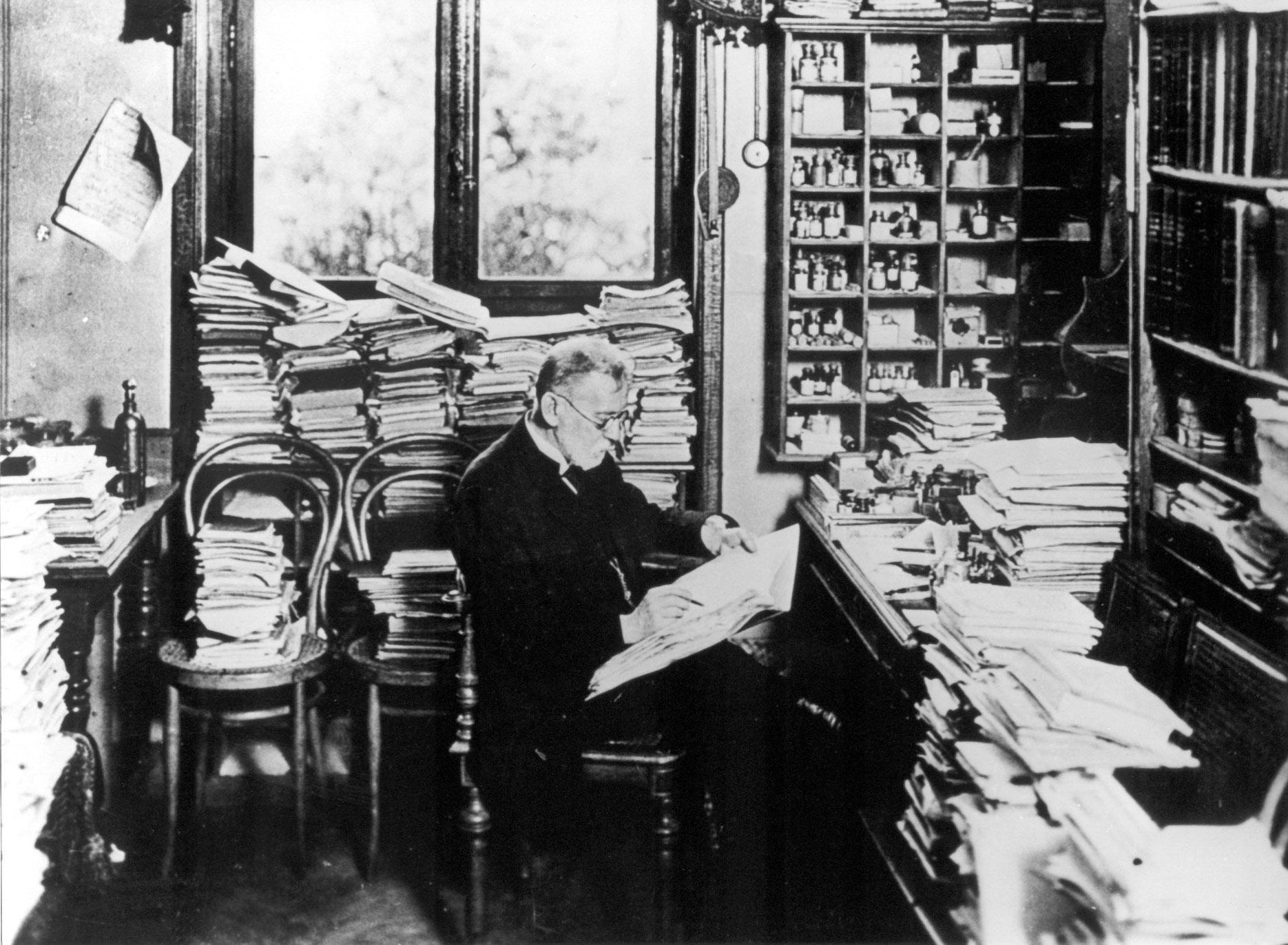
Paul Ehrlich in his Frankfurt office, 1910
Ehrlich had too much knowledge to manage.
Is it possible to have too much of a good thing? The answer is a
resounding "yes," whether the good thing is double-chocolate,
triple-layer fudge cake, or data. Knowledge management professionals in
business, government and academia are all coming to realize in this
Information Age that there is such a thing as too much information, and
it does not solely apply to your friend's vivid description of his
recent blind date.
DNA+
An insightful 2013 article in Wired, "Biology's Big
Problem: There's Too Much Data to Handle," discusses this phenomenon and
its impact on scientists involved in genetics research. There is some
irony in the cause of this informational crisis in biology, which has
largely resulted from a dramatic drop in the costs—in money and
time—of gene sequencing.
Techniques for determining the sequence of base pairs in the genome of
an organism were developed over 30 years ago. But these approaches were
very expensive and time-consuming. In 2006, the X Prize Foundation
offered a $10 million prize to spur researchers to improve genome
sequencing techniques. The prize was never awarded, but scientists
innovated nevertheless.
So much so that the costs of gene sequencing have plummeted, falling
even faster than the cost of the computer technology needed simply to
store and transmit—let alone begin to analyze—the ever-growing
mountains of data.
There's a certain degree of academic inertia that hinders efforts to
change direction and focus in scientific research. Sequencing is much
cheaper than it once was, but it's still not free, and research funding
is limited.
When funding agencies like the National Institutes of Health are seeing
ever-growing bang for their buck in terms of sheer volume of data
generated, individuals making granting decisions have strong incentives
to keep throwing money at data generation, ignoring scientists who need
funding to analyze that data with techniques that have not dropped in
cost so dramatically.
The Spy Who Loved Me Too Much
While the problem of too much information in scientific research has
gotten some attention and discussion, far more prominent recently are
revelations of the enormous volume of data collected by the National
Security Agency (NSA).
While this obviously raises many important questions about civil
liberties and government invasiveness, it also brings with it more
pragmatic problems. It's not just that what the NSA is doing is
objectionable for its violation of personal privacy. It's also
preventing it from doing its job.
A Wall Street Journal article quotes William Binney, a
retired NSA computer scientist who helped develop some of the Internet
snooping techniques used at the Agency.
"What they are doing is making themselves dysfunctional by taking all
this data."
Some of the documents released by Edward Snowden included internal
memos in which the Agency itself acknowledges these concerns. One of the
leaked reports describing the NSA's efforts to track foreign cell phones
noted that this massive data collection endeavor was "outpacing our
ability to ingest, process and store" the collected information.
Less Is More (Money)
Governments and academia are adjusting to the new paradigm in
information technology. Some businesses have been quicker, recognizing
that big numbers aren't very impressive if they don't include that
bottom line.
Companies that have successfully addressed the problem of too much
information include Boeing, Nike, Macy's and Land Rover, as detailed in
a 2013 Slashdot article.
The informational overhaul these companies initiated was
time-consuming and in most cases involved bringing in outside
consultants to objectively evaluate the inefficiencies inherent in their
knowledge management approaches. But in the end these efforts paid off
handsomely.
One key approach was to centralize their informational processing,
reducing both redundancies and discrepancies. Another was to develop and
implement software to better organize the information they had.
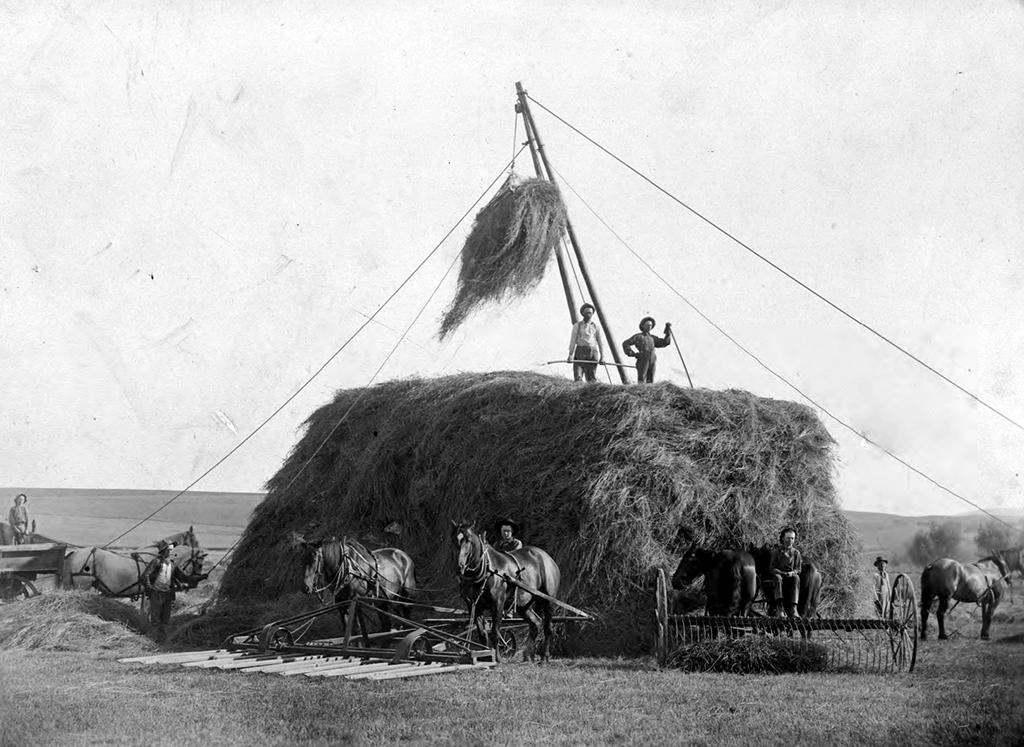
Ernest Becker, Sr. haying outfit, 1903
And of course they were able to streamline their analysis of business
data by recognizing that much of it was not relevant and was simply
making the appraisal far more complicated. When the pertinent data was
separated from this informational dead weight, analysis became much more
efficient.
If you must search for needles in haystacks, try to make the haystack
as small as possible.
Efficient Knowledge Management
A&E's popular documentary program Hoarders delighted
and horrified millions of viewers with its vivid depictions of people
with a psychological disorder compelling them to hold on to just about
everything they ever owned, whether they needed it or not, until their
lives were made unmanageable by the sheer volume of useless garbage they
could not bring themselves to part with.
But while we view these hoarders with a blend of contempt and pity,
governments, scientific institutions and multi-billion dollar companies
often find themselves in the same predicament, just with data instead
of a living room piled to the ceiling with cardboard boxes full of junk.
If you are drowning in data, consider partnering with knowledge
management experts who have experience successfully trimming down
haystacks. You might find a lot of great needles in there.