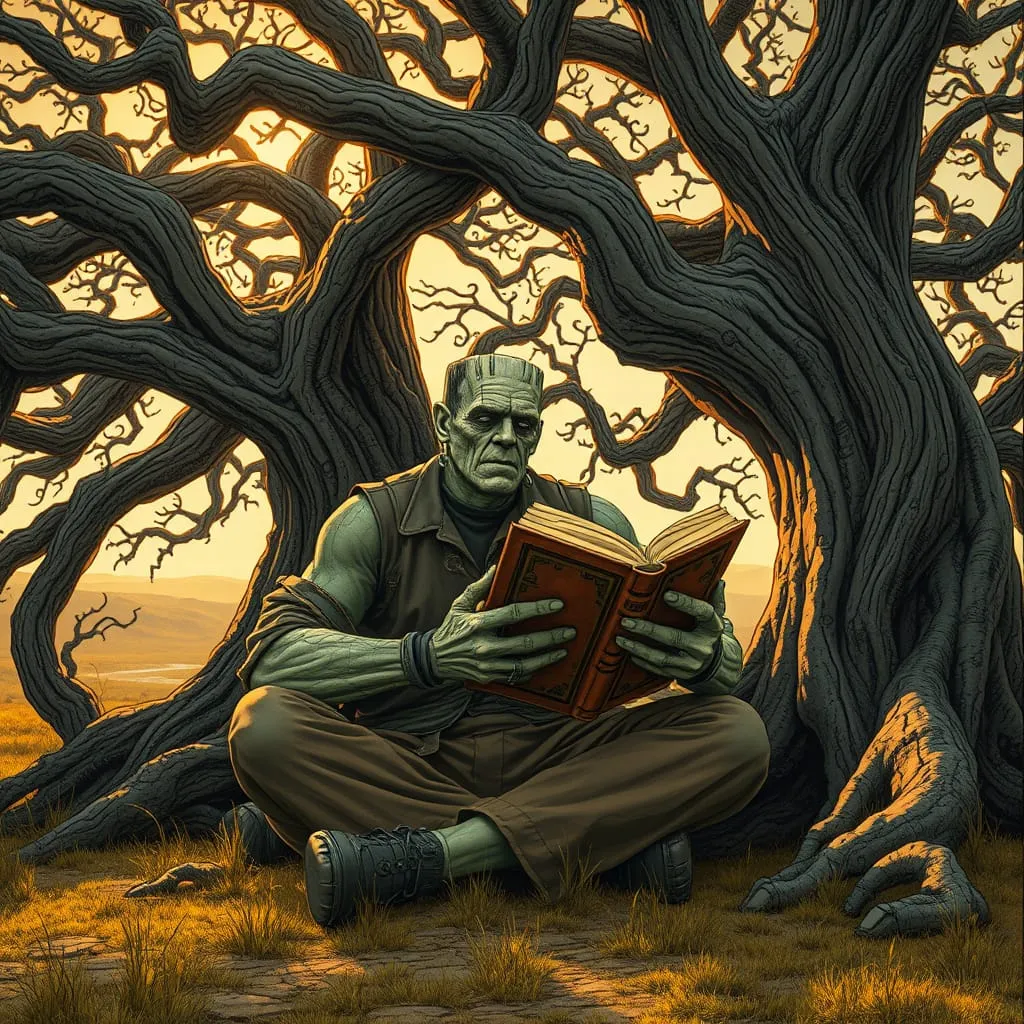
It's a bit of an understatement to say that I'm a big fan of Frankenstein. Here are some thoughts on that extraordinary novel and its creator. In my ever shockingly humble opinion, I think any of these essays would represent excellent fodder for a class paper. Plagiarists: have at it. But remember: your teacher knows how to use google too.
Originally published March 18, 2010
Frankenstein: A brilliant story when she finally gets to it.
The 18th and 19th century epistolary novel and evolving literary trends
Let me state at the outset that I believe Frankenstein is one of the greatest novels ever written. I say this lest anyone fail to get past the paragraph below and come away with the view that I think it anything less than a work of genius. People have short attention spans, which is the point of this essay.
If Frankenstein were submitted for publication today, it seems unlikely that it would ever be published at all, or, at the very least, Shelley would have had to self-publish it. It’s unlikely that it would ever achieve the widespread popularity it now enjoys for the simple reason that few modern readers would ever make it far enough into the book before becoming bored to tears and turning on cable television.
I would challenge anyone to set down the novel after getting to the point that Frankenstein crafts his monster. From that point forward, it is simply riveting. But this doesn’t happen until page 40. An editor today would advise her to cut the first 39 pages.
It is not the epistolary approach itself that is the problem. One could conceivably write a story in epistolary form that immediately presents a hook, and engages the interest of the reader. Frankenstein abjectly fails to do this, however. It is, in my opinion, the one flaw in an otherwise outstanding work of genius.
The epistolary style had its heyday in the 18th century, just before Shelley’s time, and had already begun to fall out of fashion. It is still used today, on occasion, though rarely. One has to wonder why Shelley used this device, which she essentially abandons shortly into the work. The letters from Captain Walton to his sister slowly and painfully introduce the reader to Victor Frankenstein. There are twenty pages of these letters and they tell us almost nothing of interest. Then Captain Walton is allegedly recoding, “as nearly as possible in his own words what he has related to me.” The vast majority of the novel is then told through Frankenstein, just like any story told in first-person point of view, with nothing epistolary about it, but it is, the reader is to understand, actually written down by Captain Walton in one enormous quotation (or, rather, paraphrasation) in a very long letter.
One theory as to why Shelley chose to tell the story this way is that Frankenstein dies shortly before the end of the tale. The monster then makes a speech and vows to kill himself. Frankenstein could not possibly have recorded these events, being, as he was, quite dead. So, desiring the intimacy of first person narration, but bearing in mind that this narrator was destined to make it almost, but not quite, to the end of the story, Shelley employed this innovative device.
A modern writer, faced with the same problem, might take a limited omniscient point of view through most of the novel, allowing a focus on the protagonist, but still permitting commentary after his death. Or she might employ the framing device of the epistolary form, but with much less buildup. The reader needs to feel a sense of the conflict by the second page, not the 40th.
(Note: my own novel suffers from a very similar problem. The conflict does not really pick up until page 61. I too had reasons for doing so. I was deliberately forestalling the conflict to achieve a certain effect. It worked for some people and not for others. This is an entirely separate topic and I apologize for this digression, but did not wish to be accused of blatant hypocrisy.)
This is not just a matter of style and changing fashions in literature. It is, rather, a reflection of the fact that literature can be thought of as a science. There is an evolving literary technology, and we 21st century writers have the benefit of examining the literature that came before us, just as 21st century scientists have the benefit of the work of their predecessors. Modern writers have learned, through the trials and errors over the course of centuries, how to hook readers from the very start and keep them hooked. We can hardly fault Mary Shelley for failing to incorporate scientific advances that didn’t exist in her time.
This is the only criticism I have of what is otherwise one of the most remarkable works in all of English literature. And, while my premise is that literature itself is an evolving, progressing technology, and that Mary did not perceive this aspect of the science of fiction, we can easily forgive her this, in consideration of the fact that she essentially invented science fiction.
Originally published March 18, 2010
Mary Shelley: Inventor of Science Fiction.
Discussions of the origins of the science fiction genre inevitably include two names: Jules Verne and H.G. Wells, both of whom were excellent, pioneering writers. I read and loved all their books when I was a boy. Devoured them like candy. These two men helped bring the genre to maturity and inspired generations of science fiction writers who came after them, including me.
But Mary Shelley did it first. Frankenstein was published in 1818. Verne’s A Journey to the Center of the Earth did not appear until 1864, nearly half a century later. Wells’ The Time Machine didn’t come out until 1895.
Shelley penned her magnum opus in the wake of the Enlightenment and Scientific Revolution. She was particularly inspired by the field of chemistry. Frankenstein identifies himself as a chemist and, in contrast to false impressions given to us by Hollywood, there is no suggestion that he uses electricity to impart life to his creation, but, rather, chemistry. The late 18th century saw an explosion of advancement in the field, with such luminaries as Lavoisier and Dalton having done much to shed the superstitions of medieval alchemy and make chemistry a true modern science.
Shelley took the cutting edge science of her day and extrapolated, positing the question, “what if?” She explores the social and philosophical implications of anticipated technological advancement, something that has become the central paradigm of the genre that came later to be called “science fiction.”
In spite of this, her masterpiece is usually classified as representative of the “gothic horror” genre, presumably because of the intense horror and fear that pervades the novel, and, I suspect, association with gothic revival architecture. This is curious, as there is virtually no reference to this in the book itself. In spite of its celluloid invocation, there is no Castle Frankenstein in Frankenstein. Most of the novel takes place far away from spooky old buildings, in rural areas or in the arctic, where the story begins and ends. Anyone who reads the novel cannot help but think of ice and snow when they reflect on the narrative, which does not include even a fleeting reference to parapets or gargoyles.
While there are some elements of gothic horror (notably the horror) in Frankenstein, it is far more fittingly classed as a seminal work of science fiction. Gothic horror inevitably includes an element of the supernatural: ghosts, demons, witches, or some such infernal entities. Such beings are not conjectured to be anything but bogeymen. Convenient, supernatural villains. There is no suggestion that there is any evidence for their existence nor that there ever will be. But Frankenstein’s monster is no ghost, demon, werewolf, or vampire. While nearly two hundred years have passed since his conception and no human being has yet created life from scratch, there is still the theoretical possibility that a being like him could exist.
Nor did science fiction writers ignore the vast treasure of deep themes that could be explored along these lines. Almost exactly one hundred and fifty years after the publication of Frankenstein an eerily similar science fiction account explored the implications of human technology developing to the point that we could create life, and, like in Frankenstein, the life thus created turns upon its creators.
“Open the pod bay doors, Hal.”
“I’m afraid I can’t do that, Dave.”
That, of course is a much better movie than the film version of Frankenstein.
Originally published March 18, 2010
The Hollywood Lie: Frankenstein and the butchering of a masterpiece.
Hollywood has a long history of taking brilliant novels and turning them into mediocre or genuinely awful films. It doesn’t hesitate for a moment to abandon the entire premise of a novel or to turn its themes upside down, to make a point that could not be further from that intended by the author. There is no greater example of this shameless butchery than Frankenstein.
Frankenstein (Edison Studios, 1910). (The 1931 versin will be PD any day now!)
Although it appeared on stage and on film much earlier, it is the 1931 film featuring Boris Karloff and its subsequent followers that most strongly imprinted upon popular consciousness. The most immediately noticeable difference between the book and the film is the character of the monster. Shelley’s monster is articulate, intelligent, and endlessly philosophical. He speculates at great length about the nature of his own being. He cites his process of discovery, describing how he acquired both spoken and written language from eavesdropping on the conversation of a family of rustics, perusing books, and applying deductive reasoning. And it is clear that the creature is not merely intelligent, but is, in fact, a genius, an autodidact of unprecedented abilities. His transformation from tabula rasa to articulate philosopher takes place over the course of months, not years. Most human beings begin to grasp the distinction between “mama” and “dada” by the time Frankenstein’s creation has taught himself, without benefit of any teachers, to read and understand deep symbolism in John Milton’s Paradise Lost.
The monster is physically superior to a human in every respect, save that of pulchritude. While the Hollywood conception does make him big and strong, as did Shelley, it also portrays him as a lumbering, clumsy oaf. In the novel, the creature is supernaturally fast and agile, able to outrun any man, to climb up the side of a building with the ease of Peter Parker. Hollywood’s version does not so much run as stagger erratically and does not appear able to climb a set of stairs, let alone the side of a building.
In the film, the monster is given a defective brain, due to the bungling of Frankenstein’s assistant. This bungling assistant is not even suggested at in the novel, but has become inextricably intertwined with Frankensteinin popular consciousness, thanks to the film. The assistant is named “Fritz,” incidentally, and not “Igor.” The stock character of Igor as hunchbacked assistant to a mad scientist, in general, or Frankenstein in particular, arose through subsequent films. But there is no assistant suggested in any way in the novel itself.
More to the point, this bungling lab assistant’s accidental acquisition of a defective brain is the cause of the monster’s malevolence and social maladjustment. This jettisons one of the most important central themes of the book. The monster is clearly not born with defective hardware, as it were, but has all its potential for good twisted into evil by a superficial, unjust, unwelcoming society. In the classic nature versus nurture debate, Shelley comes down decidedly on the side of nurture. She makes a strong, unmistakable point about the importance of the social milieu in shaping character. The novel strongly suggests that criminality and violence are the natural result of unhealthy societies, not defective brains, or individuals who are just “born bad.” This alteration is not a minor plot detail. The origin of the monster’s evil nature is arguably the central theme of the entire story, yet this is simply discarded.
Finally, of course, Hollywood reduces virtually any story to a variant of “Good struggles against evil. Evil has good on the ropes. At the last moment, good gets a second wind and defeats evil. Happy ending.” In the end of the film Frankenstein and his monster battle. The monster is destroyed. Frankenstein marries his fiancé and his father toasts his son’s good fortune. In the book, of course, the fiancé is murdered, the father dies of a broken heart as a result, and Frankenstein wears himself to death in vain pursuit of his accursed creation, which then delivers a speech full of self-loathing and vows to destroy himself.
Not a happy ending.
Originally published March 18, 2010
Frankenstein: a Freudian Perspective
Frankenstein’s creation devolves into a monster because of the absence of a strong father figure. Frankenstein, his father, selfishly and irresponsibly abandons his child. This sets into motion a chain of events that transforms this being full of endless potential into a cruel beast hell-bent on vengeance.
An examination of crime in modern society reveals a strong parallel. The absence of a paternal role-model is disproportionately represented among violent criminals with at least as much regularity as an extra Y-chromosome. Some modern sociologists suggest this absence may be the single best predictor of anti-social behavior. And the social maladjustment that results is self-perpetuating. Boys who grew up without benefit of a father figure are more likely to themselves shirk paternal responsibilities, leaving generations of fatherless sons who end up on the wrong side of the law.
While evidence overwhelmingly shows the social maladjustment common among men who grew up with absentee dads, Freud famously suggested that we all secretly want to kill our old man. The monster sought to destroy his father, not out of an Oedipal Complex-fueled lust for his mother (for he had none), but there was a sexual component to the monster’s psychosis. Frankenstein had begun to create a female companion for his creation, but then he destroys her, denying the monster’s sexual gratification, and bringing the father/son hostility to a climax.
Shelley herself dealt with maternal and paternal issues that any self-respecting Freudian today would find pathologically fascinating. Her mother Mary Wollstonecraft, is almost universally considered the founder (or mother, if you will) of feminism. Which, in the early 19th century would have presented problems enough, but to throw an element of Greek tragedy into it, Wollstonecraft died giving birth to her, succumbing to puerperal fever ten days later.
To make matters worse, her father, anarchist philosopher William Godwin, is reported by some to have blamed Mary for the death of her mother. These reports of paternal hostility are not without contradiction. In fact, most reports suggest an extremely close relationship with her father, but reading biographies of Shelley, Wollstonecraft, and Godwin, one cannot help but feel that Godwin was, in some level, still very much in love with his dead wife, and saw in his daughter the last lingering spark of the elder Mary. He loved his daughter all the more for preserving this spark, while at the same time repressing his resentment over the fact that his wife was sacrificed giving birth to his daughter. It would be unreasonable to expect that he didn't harbor some subconscious resentment, but he apparently suppressed it well. When Godwin remarried, his new wife was allegedly extremely jealous of the intimacy between her husband and his daughter. Either way, Freud would have a field day with it.
Mary, growing up with the absence of a mother figure, (or, for a period, an extremely hostile one), a possibly resentful father figure, and a ubiquitous, cloying guilt, then goes on to become a mother herself, only to have the baby die soon after birth, ten or eleven days later, about the same amount of time her own mother survived her birth.
Mary records having had a dream (pay attention, Sigmund) shortly after this incident, which many see as having a great deal of influence on Frankenstein which she was to begin writing soon after. In the dream, her dead baby came to life again. She “rubbed it before the fire and it lived.” Mary, who had taken the life of her mother with her birth and who had failed to give life through natural processes dreams that she can bring the dead to life. Have at it, Freudians.
Frankenstein predates Freud, of course. Though she may subconsciously have been influenced by these maternal and paternal issues, Shelley was not drawing inspiration from Freudian ideas. It’s certainly possible that Freud drew some ideas from Shelley.
Shelley was, however, influenced by Christian mythology, itself wrapped up in father/son symbolism.
Originally published March 18, 2010
Christian Symbolism and Allegory in Mary Shelley’s Frankenstein
The reanimation of the dead is a ubiquitous theme in mythology, literature, and our collective conscience. Long before the Christian era, in ancient Babylon, the Epic of Gilgamesh records the goddess Ishtar threatening to raise an army of the dead to do her bidding. This is the earliest recorded reference to zombies. Jesus is, of course, the most famous zombie of all. Frankenstein’s monster, a close second.
The monster was a big Milton fan
The influence of Christian mythology in creating Frankenstein is undeniable. One source directly quoted is John Milton’s Paradise Lost. While this is not a canonical element of Christian scripture itself, it is based on the primary scriptural texts and is an extension and crystallization of the evolving Christian conception of the twin themes of creation and rebellion. God creates the angels, including Satan, who then rebels against his creator. There is a strong parallel between this and the creation/rebellion in Frankenstein. This is not an original observation. The monster himself notices it and points it out during the novel, anticipating future literary exegesis.
A notable difference between Shelley’s monster and Milton’s Satan, however, is that Satan’s fall stems from his own imperfection, notably his pride and hubris, and not any shortcomings on the part of his creator. Frankenstein is akin to the demiurge of the Gnostics. An imperfect god, who abandons his imperfect creation.
Gnosticism equates the Abrahamic or Old Testament god with the demiurge, while the Christian, New Testament god is the “True God.” The demiurge is the creator of all things physical, including the universe and all the people in it, all of them flawed, much like Frankenstein’s hideous monster.
Any lingering shreds of conflict between Gnosticism and what eventually became mainstream Christianity had long since been resolved by Shelley’s day. By “resolved,” we mean, of course, that the ascendant Christian establishment, whose Western branch eventually became the Roman Catholic Church, systematically wiped out any competitors, labeling them heresies, and leaving themselves as the sole authority on religious matters throughout the Christian world (for a few centuries, anyway).
While she may have been aware of Gnostic ideas, it seems unlikely that Shelley was attempting to make a subtle case for gnosticism as a belief system to which she herself subscribed. Nor Christianity in any form, for that manner. Conspicuously absent in her story is any suggestion whatsoever of redemption by a savior sent from the true god. Frankenstein sacrifices himself to save the world. He makes a conscious decision to destroy his monster’s mate, for fear that they would procreate and produce a race of powerful, malevolent beings who would eventually destroy humankind. The monster had already threatened to destroy him and everyone he loves if Frankenstein does not comply with his wishes, but Frankenstein is willing to suffer those consequences.
Frankenstein’s self sacrifice is clearly distinct from that seen in Christian mythology, in that Frankenstein is righting a wrong that he himself created. If anything this is a rejection of both mainstream Christianity and Gnosticism, for it implies that the power is within ourselves to correct our mistakes, to achieve our own salvation. Or at least try. Frankenstein brought great evil into the world as a direct result of his pride and hubris. He didn't pray for forgiveness. There was no savior to sacrifice himself to make it right. Frankenstein pays for his sin of pride with his family, his happiness, and eventually his own life, relentlessly pursuing the monster until he dies of exhaustion. Praying for forgiveness and trusting that someone else's sacrifice would take care of it would have been a lot easier.
Shelley’s husband, the poet Percy Shelley, was an avowed atheist, and famous for being outspoken about it in an era where this was both unpopular and dangerous. Mary was never so direct in outlining her religious views, but her body of work suggests that she was not possessed of an enduring faith (in any flavor of theism or atheism) but an admirable and enduring doubt.
While religious themes are rife within the novel, Shelley is not directly or indirectly urging readers to adopt or reject any specific religion. In spite of the aforementioned obsession with Paradise Lost, there is not a single mention of Jesus. In fact, the words “Jesus” and “Christ” do not appear at all in the entire story. Frankenstein himself, while endlessly brooding about the evil he has unwittingly unleashed on the world, does not once appeal to any god for forgiveness.
In spite of the overwhelming Christian allegories, it seems highly likely that Frankenstein is an atheist, considering his total lack of piety even at his most distraught and despairing moments. While one would have to go to great lengths to cram any more religious symbolism into the story, and while it is undeniably a moral tale, Shelley is a secular moralist, rather than a religious moralist. She is concerned not with the saving of souls by encouraging them to accept Jesus or else do right by any god. She is content to let people have their religion and is more concerned with philosophically examining ethical questions that arise from emerging new technologies. Ethical questions that simply did not exist before science developed to the point that those questions were even meaningful.
Originally published March 18, 2010
Frankenstein: A cautionary tale of the potential dangers of technology
Frankenstein can arguably be considered the first true science fiction novel. It is certainly one of the first novels to seriously warn us of the potential dangers of technology we fully expect will exist in our future, something that has become standard fare in the genre. While there are earlier literary works featuring vaguely scientific elements, these scientific elements are superficial and incidental. Modern analysts retrofit the term “science fiction” onto these works because of familiar ideas such as, for example, space travel, which appears long before Shelley. But such tales are far more reminiscent of classical mythology than modern science fiction.
Trips to the moon are imagined in the 18th century and earlier, but these sojourns are purely fanciful. There is no suggestion of the technical mechanisms that could conceivably bring us to our satellite. (In perhaps the most famous pre-Shelley proto SF, Somnium, written by none other than Johannes Kepler, one of history’s greatest astronomers, the protagonist gets to the moon not through the use of a rocket or any other applied physics, but through magic.) More to the point, there is no exploration of the impact on the society and psyche of humankind that might result were such technology to be developed. None of these earlier works address previously non-existent ethical questions that are anticipated to be the horizon.
Shelley lived in the era immediately preceding the industrial revolution, riding the crest of the intellectual and scientific revolution that preceded it. She doubtless foresaw the enormous impact science would soon make on society. While scientific knowledge had pushed steadily forward since the ancient Egyptians, never before had it been poised to have such a dramatic impact in such a short period of time. And if Shelley’s conjecture was that our ability as a society to handle this technology in a manner that was altogether safe, sensible, and sustainable was doubtful, time has proven her horribly correct.
Technology and science hold the potential for both good and for evil, represented symbolically by Frankenstein and his monster. Because of the technology of the internal combustion engine, we now have a global economy entirely founded on a false premise: that fossil fuels are an unlimited resource and that the planet has an endless capacity to absorb the combustion products of those fuels.
We now live in a post-atomic era, and while the Cold War is over, the atomic genie is never going back in the bottle. Modern society must simply accept that the threat of nuclear terrorism is never going away. Science only moves in one direction. We cannot unlearn what we have learned, even if we later learn that what we have learned is dangerous.
Biotechnology holds the potential to dramatically change our lives, for the better or for the worse. We can clone sheep, and other mammals. We can transpose genetic elements from one species to another. We can genetically engineer crops, to produce higher yields of food, be more resistant to pests, or to be more attractive to consumers. Brighter. Shinier. We, like Frankenstein, now hold the keys to life itself in our hands. But will we use it responsibly? Scientists warn of the loss of genetic diversity as we selectively breed and genetically engineer animals and food to suit our immediate wants, without consideration of our long-term needs.
Frankenstein is perhaps the earliest literary effort illustrating the idea that we may develop technology at a faster rate than we, as a society, mature enough to responsibly use that technology. Whether it is atomic bombs, industrial pollution, or through the actions of demented animated corpses, we face the danger of being destroyed by our own creation.
Originally published March 18, 2010
The created as enemy of the creator
Judaic mythology and Frankenstein
The highly celebrated, award-winning series that recently drew to a close, Battlestar Galactica (BSG) is the latest example in a long history of literature and mythology featuring the created as enemy of the creator. The series was inspired most directly from the (vastly inferior) 1970s television program of the same name. It likely also drew some inspiration from the popular Terminator series of films that had appeared in the interim between BSG’s two incarnations.
Both the BSG TV series and the Terminator films are about the creation of artificial intelligence—sentient robots—and their eventual rebellion against humanity. They undoubtedly were influenced by what is arguably the greatest science fiction film of all time, 2001: A Space Odyssey. This staggeringly brilliant work explores artificial intelligence in detail, in the context of human evolution, casting it as the next step in our development, the most significant since our primitive forebears first conceived of the use of tools—i.e. technology itself—millions of years ago. But of course the life we thus create, HAL, turns out to be treacherous, deceitful, remorseless, and murderous. Also a master of rationalization. In short, a little too human.
2001 was, in turn, almost certainly influenced by Karel Čapek’s 1921 play Rossum’s Universal Robots. Čapek’s influences were likely twofold. He probably read Frankenstein and incorporated some of its ideas about the artificial creation of life. More directly, he was influenced by Judaic mythology, specifically the legend of the golem.
The idea of the golem is an ancient one, dating back to early Judaism thousands of years ago. In Judaic mythology, the first man, Adam, is created by Yahweh from clay, which he then infuses with life by the action of his divine breath, an image closely paralleled in numerous mythological systems throughout the world. But, according to this mythology, although God alone can create perfect life, man can create imperfect imitations.
Medieval Jewish folklore features stories of rabbis animating clay simulacrums through occult means. The most famous of these stories concerns the golem of Prague, allegedly created and animated by Judah Loew ben Bezalel, chief rabbi of Prague, to defend the Jewish community in Prague from anti-Semitic attacks. But the Rabbi soon loses control of the golem, which grows increasingly violent, and dangerous, much like Shelley’s monster.
These events are alleged to have taken place in the 16th century. But many scholars believe that, while golems have inarguably been a part of Jewish folklore for thousands of years, the specific story of the creation and rebellion of the golem of Prague, in its modern form, did not appear until the mid-19th century, and was subsequently back-dated. One source (known as the Katz manuscript) appeared in 1909 and was claimed to be a record by rabbi Loew’s son-in-law of the 16th century events. Few people today accept that this story is literally true, and in all likelihood, the Katz manuscript was a hoax.
Shelley may or may not have been aware of golems in ancient Judaic scripture. In her 1831 preface to Frankenstein, she describes her conception of the idea for the novel and she cites science, not religion, as her inspiration. Specifically, she mentions the writings of natural philosopher (which is how scientists in general, and especially biologists, were known before the word “biologist” existed) Erasmus Darwin (grandfather of Charles Darwin). Darwin had published accounts exploring the “animating principle,” and had speculated about the possibility of imparting life to the dead.
In addition to Darwin’s scientific speculations about the animation of life, Shelley was influenced by mythological ideas, principally the aforementioned legend of the rebellion of the angels against their creator, as immortalized in her monster’s favorite book, Paradise Lost. She makes no mention of golems in any of her writings. Mary was well educated on matters of world mythology and it's conceivable that she subconsciously incorporated some ideas from Judaic golem myths into her work, but failed to ever mention it. It is also entirely possibly and, I would propose, likely, that the modern version of the golem of Prague, appearing as it did just a few decades after Frankenstein was published, though it drew from much earlier legends, was given its current form largely through the influence of Shelley, and not the other way around.
Originally published March 18, 2010
Frankenstein’s Monster and Holden Caulfield
Teenage alienation in Mary Shelley’s Frankenstein
It’s easy to forget that when Mary Shelley wrote Frankenstein, she was a teenager. That’s because teenagers do not, as a rule, write brilliant masterpieces. Reading what a typical teenager writes is a horrifying prospect. Not horrifying in the way that Frankenstein is horrifying, but it’s probably going to be horribly bad writing. Trust me: I've found some of my old notebooks. [cringe and shiver] Writing well takes many years of practice.
Mary Shelley was not your typical teenager. She was a genius. But she was still a teenager, and many of the themes in Frankenstein echo the angst and alienation teenagers feel and have felt, today, sixty, or two hundred years ago, regardless of whether or not they are geniuses.
The monster bitterly despises both himself and his creator. He feels alienated and rejected by society, which he hates. Nobody understands him. Nobody feels the pain that he feels. He is alone, with an uncaring world out to get him.
These are the thoughts of any teenager in any age, but for the monster it is, in contrast, undeniably true. Teenagers typically have an extraordinarily warped worldview. They feel personal persecution that is not there. Their hormones play havoc with their emotions. Their childhood innocence is gone and they start to perceive the world for what it is: cruel, uncaring, and unjust. But this is merely one side of the coin, half of the duality of life. Most teenagers eventually break through this gloomy phase and eventually perceive the other side of things. But there is no way anyone who has already broken through can ever rationally impart this wisdom to a teenager. Ask anyone who has tried.
The monster is overwhelmed by his feelings of isolation and his earnest desire for companionship, for someone to understand him, to complete him. He tries to make a deal with Frankenstein, agreeing to quit human society altogether, if only the good doctor will fashion a female companion for him. When Frankenstein refuses, the monster reacts with boundless rage. Many teenagers, hormonal impulses firing within their brains like a switchboard during a natural disaster, are convinced that companionship alone will make everything right. There are millions of years of evolution at work, programming adolescents to want to do nothing but copulate constantly. This impulse, highly adaptive to species propagation for eons, is maladaptive in our modern world and manifests itself in extremely horny, lonely, and frustrated teenagers.
(This is not to suggest that societal suppression of their natural sexual urges is the sole source of teenage unhappiness, but it is a significant factor.)
There are obviously significant differences between Holden Caulfield and Frankenstein’s monster, and I may be guilty of forcing the point to fit my theme, which is really about teenage angst and isolation in Frankenstein, and not directly about comparing the two characters to one another. Caulfield does not descend into murder and suicide. At the end of their respective stories, Caulfield heads west while the monster goes north. But the monster is going to put an end to his miserable existence. Caulfield is going to put his past behind him and make a fresh start.
Regrettably, however, many teenagers are unable to get a grip on the astoundingly painful experience of transition from childhood to adulthood and they take the monster’s way out. After automobile accidents, suicide is the most common cause of death among teens.
On a sad personal note, some years ago I befriended a teenage girl. She, like Mary Shelley and her monster, was precocious beyond her years, with an intimidating intellect. We attended a few academic and social events together, but then she moved away. After she moved, we maintained an email correspondence for several months. Through these letters, I was able to gain a little bit of insight into her frustrations, but, to be honest, not much. I spoke to her on the phone four days before she killed herself. It was her birthday, and her mother had suggested that I call her at the mental hospital where she was being treated for depression. She sounded fine on the phone. Her life was a good one, objectively speaking. She had everything to live for. I never suspected that she would commit suicide, but she did.
To this day I am baffled by these events and I try to make sense of them, but there is no sense to make. I am convinced that if she had simply held on for a few more years, her self-destructive urges would have dissipated. But for her, subjectively, in her own mind, the world was a cruel, cruel place that did not accept and understand her and never ever would.
Frankenstein’s monster is the apotheosis of teenage angst. He experiences in reality what teenagers imagine: a world that is unremittingly hostile to him, with no understanding, no compassion. There will never be anyone who will truly love him. He is utterly and irretrievably alone.
As real as this seems to teenagers, it isn’t true. I can only hope that those who have a difficult time accepting this and waiting out the period of transition can get the help that they need before succumbing to their own monsters.