Selected short fiction
Originally published in the program accompanying Thread the Labyrinth, 2001.
Copyright © 2001 Andrew Breslin. All rights reserved.
The scent of gingerbread crawls and claws and shimmies up my nose and wiggles. Even the most independent, free-willed salivary glands are helpless before the olfactory onslaught, and I am carried back in time, my mouth filling with drool, and my mind with thoughts of M.C. Escher.
Mother adored the great woodcutter and lithographist, his extraordinary forms, glorious in mathematical precision. At the time I was uninterested in mathematics and found no especial joy in his impossible figures, polyhedra, and assorted non-Euclidean geometries. And my interest in tessellations, it must be confessed, was due entirely to the sugar cookie lizards mother inexplicably began baking one day.
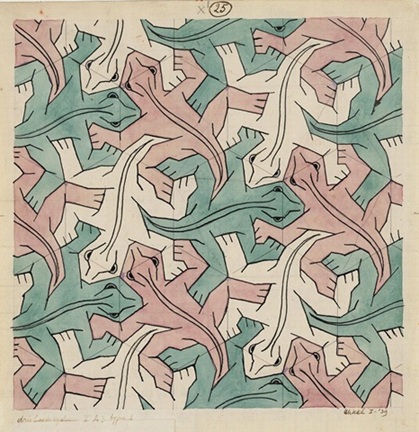
The first batch were right out of Symmetry Drawing 25. Yellow, green, and red, as in Escher’s work, thanks to the miracle of food coloring. The delicious confectionery reptiles fit together in endless combinations. Mother explained that a tessellated pattern would seamlessly cover an infinite plane. I had only a vague idea what this mental abstract was, this infinite plane, but I knew it had something to do with more cookies than I could begin to imagine.
How Mother got it into her troubled head that she was the secret lover of the pioneering Dutch artist, nobody ever really discovered. He died in 1972 at the age of 73. Mother was but 26 then and as far as anyone knew, had never been to Holland or slept with a woodcutter even once.
By some mysterious process of neurochemistry her psychosis brought with it a welcome genius for baking, and she made cookies in the shapes of the subjects of Escher’s stunning tesselations as a tribute to her love. Before her descent into madness, she was a fine mother, but a lousy baker, and her dementia was nothing but a windfall for her sugar-deprived scions. My younger brother Chip and I spent hours fitting the shapes together, or, when that grew tiresome, waging lizard wars.
Father took it remarkably well, his wife having essentially forgotten his existence and invented a life she thought she shared with the maker of devils and angels, impossible buildings, tessellations and labyrinths. “It’s happened before. She’ll come ‘round,” he said. “Before you kids were born. She baked those funny cookies and talked about this Escher character. Then after a few days, she snapped back. She’ll be okay. Don’t worry,” he said, then returned to smoking his pipe and reading the financial section of the New York Times.
Worry. What could he possibly be thinking? I’m up to my eyeballs in cookies here, I thought. I hope it lasts forever.
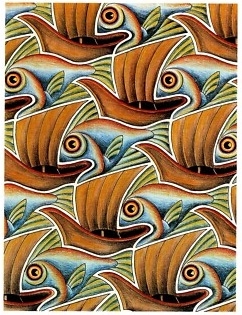
She’d started with the lizards, just before the end of the year, and on New Year’s morning an aroma that had never before been smelled this side of heaven came into my room, lifted me out of bed and carried me down to the great tessellation factory that our kitchen had become. Blondies and brownies in the shapes of the fish and boats from Escher’s Symmetry 72. Each fish enjoyed a gumdrop for an eye. The boats had to settle for frosting.
Pulling some books from Mother’s library, I learned that Symmetry 72 was done for a 1949 New Year’s card Escher had been commissioned to do. So it all made some sort of sense, at least, and I for one, was opposed to Father’s decision to seek professional help.
Another week of sweet glory passed before Father, out of concern both for her mental and our dental well-being, finally made an appointment with a psychiatrist. We all went along to facilitate the therapy. Chip and I went under protest, of course, and only cooperated through bribery with some stellated dodecahedron macaroons Father had commandeered.
Mother waited in another room while Dr. Hazard questioned us. Father explained the situation and Dr. Hazard alternately scratched his bearded chin and balding head, professionally pensive.
“It’s a rather unusual manifestation,” Dr. Hazard mused. “Delusions that the individual is a famous historical personage are not markedly rare, but I’ve seen few cases where the patient imagines she is the lover of a Dutch woodcutter she never met. And the bit about the cookies, well, that’s one for the books.”
“I’m sure it’ll give you a wonderful opportunity to get a paper published in one of your fancy journals,” Father said, excusing himself to step outside to smoke his pipe. I seized what seemed my only chance to save the threatened cookie supply.
“I don’t know what the old man is talking about,” I told Dr. Hazard in a discreet whisper. “She’s always baked these cookies.” I suggested that father’s high level of stress had brought on his delusional fantasies and that what he really needed was a long vacation, far away from his nagging wife and insolent children. Dr. Hazard didn’t buy it. Never try to use psychology on a psychiatrist.
He prescribed a pharmaceutical smorgasbord. Mother was on L-Dopa, Thorazine, Lithium, Haldol, and even electric shock before we finally realized that Dr. Hazard was a quack.
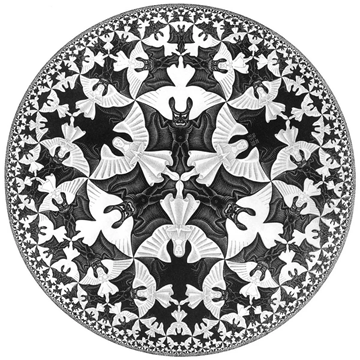
While Father was seeking a better shrink, Mother reached new heights of confectionery brilliance. The highlight was her stunning recreation of Escher’s masterpiece Angels and Devils using, yes, angel food cake and devil’s food cake. It was such a work of genius that I mulled over the phrase “too pretty to eat” for upwards of five seconds before devouring a few seraphs and imps.
The following day, Father packed us off to see another therapist, one Dr. Denison, who I hoped and prayed was equally incompetent. She greeted us with a wide smile of unnaturally white teeth, and brought us all into a dimly lit room. Dr. Denison carried a certain calm about her, and Mother relaxed enough to answer a few questions while we sat back quietly as instructed.
“Where is Mr. Escher now?” Dr. Denison asked.
“He’s . . . he’s . . . .”
She became nervous, agitated, and Dr. Denison was unsure her line of questioning was the most therapeutic. “I can’t find him!” Mother screamed in a panic.
“Relax,” Dr. Denison said soothingly, taking Mother’s hand.
“Maurits, I am lost in your labyrinth!” She shouted in her delirium.
A nagging, unfamiliar sting of compassion gripped me, and for the first time I saw the situation in terms unrelated to desserts. I pitied her loss of dignity more than anything else. I could not fathom the tortured state of her mind.
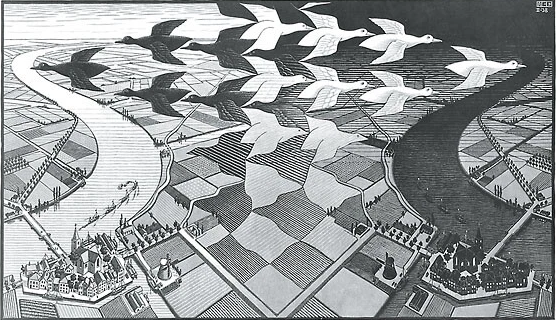
I vacillated between concern for my mother and lust for sugar. When we returned, she went directly to the kitchen, shrine to her imagined paramour, and in a few hours we feasted on black and white geese from out of Day and Night, arguably Escher’s most celebrated accomplishment, and inarguably one of Mother’s greatest. She used a classic sugar cookie recipe for the light colored ones. Gingerbread with chocolate for dark. Delirium was never so delicious. But as I wiped my chin, I worried, I really did.
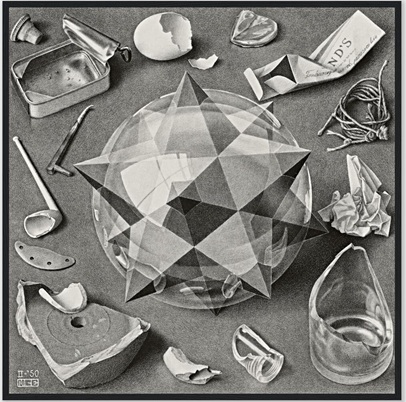
We had another session shortly afterward. Dr. Denison questioned her about the cookies but Mother’s answers made no sense. The doctor brought out prints of Escher’s works, observing her reactions. She fell deeper into her delusion, becoming lost in the corridors of her mind when Dr. Denison produced Order and Chaos. Polyhedra and spheres, visually and mathematically perfect, amidst distorted irregular debris. Much like mother’s troubled psyche as she baked tessellated cookies. Disoriented and afraid, she wandered the halls of her bizarre cerebral dungeon, where parallel lines routinely meet and Euclid’s fifth postulate is laughed at. .
“She may return to her senses more quickly if she is not encouraged by positive feedback concerning aspects of her mania,” Dr. Denison suggested.
My limited vocabulary did not allow a complete interpretation of this cryptic diagnosis, but some sixth sense allowed me to gather enough from context to grasp the horrible truth.
The scent of the möbius strip tortes mother prepared the following day could have coaxed drool from a man about to die of thirst in the middle of the Mojave. Flattened strips of dough, given a half twist and one end then mashed back flat onto the other. Mother showed us that möbius strips were truly magical constructs. Two-dimensional surfaces twisted through three-dimensional space, each with but one side and one edge. As strange as that, yet they survived perfectly well in the harshly normal environment of our familiar Euclidean geometry. And, what was more impressive, they were covered with confectioner’s sugar.
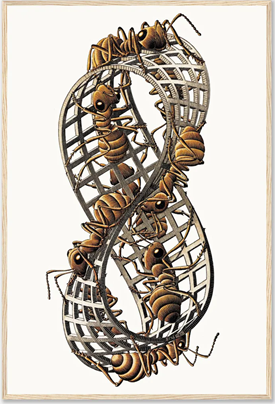
In Escher’s best known representation of a möbius strip, there are ants crawling all over the strange one-sided topological curiosity. These, too, I left for the ants.
“I don’t want any more cookies or cakes or tortes,” I said. “I just want my mother back again.”
She didn’t return immediately, and if this incident at least nudged her toward the exit of her labyrinth, she never said so. But somehow I knew it was important, though I don’t know why, any more than why she came to believe she was Escher’s lover in the first place, or how this delusion was associated with that area of the brain devoted to baking. Within a few days, she found herself back in our world, where our space is three-dimensional, our geometry, Euclidean, and that’s the way we like it.. We were glad to have her back. Glad she’d found her way out the maze of her mind, following a trail of cookie crumbs.
But now I must salivate and I must worry. I smell mother baking Escher cookies again.