Originally published on January 26, 2013.
You can’t live in Philadelphia very long, or, indeed, anywhere outside of a box, without hearing the bustling little metropolis on the Delaware referred to as “The City of Brotherly Love,” but many, even lifelong Philadelphians, veins full of cheese steaks and water ice, don’t give much thought to where that famous nickname comes from.

History does not note whether or not he loved him.
William Penn, the founder of the great urban experiment of the New World, named the city Philadelphia, and it means “brotherly love” in Greek. You can see the Greek root philos, love, right there, and the less familiar adelphos, brother.
Pennsylvania, the state in which we find Philadelphia, means “Penn’s woods,” this time from Latin, not Greek. The familiar Latin root sylva, meaning “woods,” appearing in words such as “sylvan,” is just sitting there behind “Penn.” Technically, the “Penn” in “Pennsylvania” refers to our founder’s father, also named William. The charter for the area of land now bearing his name was payment on a debt owed by England’s Charles II to the senior Penn. William Penn Sr. died in 1670, so Charles II granted the charter to Penn’s son in 1681.
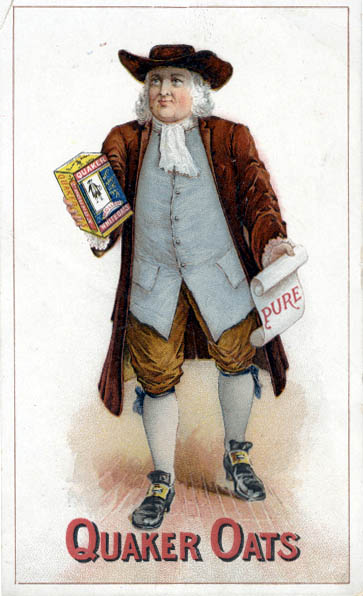
William Penn (the younger) was a Quaker, and wished to create a haven of religious tolerance, a radical concept in those days. Although the charter for Rhode Island (1663) includes a declaration of the right to religious liberty, there were few other examples and Quakers were persecuted mercilessly back in England. Penn wrote religious freedom into law when Pennsylvania was given to him by Charles II, and his vision for the city he named Philadelphia was to embody the quintessence of tolerance and brotherly love.
Quakers are well known for their peaceful proclivities, resisting warfare, and taking biblical instructions to love one’s brother quite literally. Philadelphia still has one of the largest populations of Quakers in the world. Penn was also noted for establishing friendly relations with the native populations, in stark contrast to most of his contemporary European counterparts.
So, pretty much from its inception, Philly has been well-deserving of its name. But there were two cities named Philadelphia long before the city of brotherly love we know today. One was founded in the 2nd century CE by Attalus II Philadelphus, king of Pergamum. The location is in modern-day Turkey, but a city called Alasehir sits there now.
The other is even older: In the third century BCE, Ptolomy Philadelphus, King of Egypt, captured Rabbath Ammon, then capital of the Ammonites, in Palestine, and renamed it Philadelphia. The site is near present-day Amman, in Jordan.
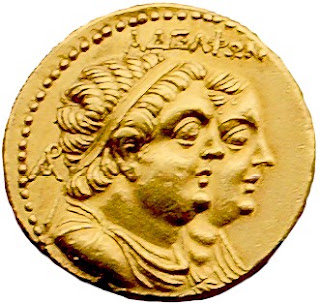
Clearly these cities were not named specifically to reflect the desires of their founder/conqueror, respectively, to embody tolerance and love for one’s brothers. They were brazen displays of egotistic hubris. But their names had the same ultimate root. Pergamum had been dominated by Macedonians for centuries by the time of Attalus II Philadelphus, so the Greek name comes as no surprise.
The royal lines of Egypt were no longer Egyptian after the 30th Dynasty (circa 4th century BCE). The Ptolemaic dynasty (32nd) was established by Greeks, thus Ptolemy Philadelphus’ name is Greek and derives from the same roots, but Ptolemy Philadelphus was certainly motivated by less noble urges than William Penn. It is odd that he would charge into a city and conquer it, spilling buckets of blood in the process, and then name it “brotherly love,” but that’s what he did. One would imagine, however, that he didn’t give much more thought to his name than people do today. If someone named Cooper, or Smith were to found “Cooperstown,” or “Smithville,” one wouldn’t expect them to be filled with people making barrels, or hammering iron, but those are origins of those names.
Adelphos has not made its impression on English as strongly as philos has. The latter root shows up in some very common words, including philosophy, philanthropy, philanderer, anglophile, francophile, and bibliophile (in fact a whole host of -philes. One could start a file on them!) Adelphos, on the other hand, brings no words to mind, apart from Philadelphia. Armed with my Webster’s Unabridged, however, I found two:
- Adelphia, n: in botany, a bunch or bundle of stamens: used of those plants in which the stamens, instead of growing singly, combine by the filaments into one or more parcels.
- Adelphous, adj: in botany, forming an adelphia or adelphias; uniting by the filaments into one or more parcels: said of stamens.
News to me! And I was a biology major. But you can see how the word would be appropriate under the circumstances. Stamens are the “male” parts of plants, and this bundling together can be seen as “brotherly.”
The Oxford English Dictionary lists another:
- Adelphogamy, n: The mating of brothers and sisters, as in certain ants.
Not a term most people have cause to use, outside of entomology, West Virginia, or the Ptolomaic Egyptian dynasties.
It also lists the words “Philadelphian” and “Philadelphy,” both of which mean, “brother loving,” though it is almost certain that most people hearing the words would probably take the former to mean, “someone from Philadelphia,” and the latter to mean, “characteristic of Philadelphia.”
Although adelphos hasn’t made much of a splash on English, some words that might be created by combining adelphos with other Greek roots are:

- Adelphobic: afraid of one’s brother
- Polyadelphic: having many brothers
- Hyperadelphic: the state or quality of being a “big brother”
- Hypoadelphic: the state or quality of being a “little brother”
- Adelphopyrogenesis: setting one’s brother on fire
The Greek words adelphos and delphis (the Greek origin of the English “dolphin”) are similar enough to provoke an amateur etymologist to wonder if they aren’t connected. Dolphins are highly intelligent, and there have been numerous well-documented examples of altruistic and magnanimous behavior of these mammals toward us. And while they look very much like fish, they are much more closely related to us. Dolphins and humans are much more “brothers” to one another than either are to fish.

but this dolphin might.
This fact wasn’t lost on the ancient Greeks. Both words stem from the Greek delphus, meaning womb. Adelphos means “from the same womb.” They called the animal delphis, because they discovered that this “fish” differed from the others in that it, like people but unlike actual fish, had a womb.
It’s reasonably common knowledge that the famous oracle and temple of Delphi was dedicated to the god Apollo, but it is less well known that the name comes specifically from the cult of Apollo Delphinios, i.e. the god worshipped in his incarnation as a dolphin.
 Photo © Terry Foote,
licensed under
CC BY-SA 4.0
.
Photo © Terry Foote,
licensed under
CC BY-SA 4.0
.
The dolphin might make a good mascot for a Philadelphia sporting franchise. Sadly, Miami has laid claim to the womb-fish, and Philadelphia has the eagle instead. For its football team, anyway. Its baseball team has the “Philly Phanatic,” the specific species of which has not been determined, but it appears to be some sort of hirsute green mutant clown.
None of the preserved writings of William Penn mention either dolphins or mutant clowns, but being the Quaker that he was, I have little doubt that he would have loved them both like brothers.